The Best Kitchen Knife Set: Which Knives You Actually Need (and Which to Skip)
The best kitchen knife sets for every budget, which knives you really need, German vs Japanese steel, and how to keep your knives sharp for years.
We earn a commission if you buy through links on this page, at no extra cost to you. Learn more.
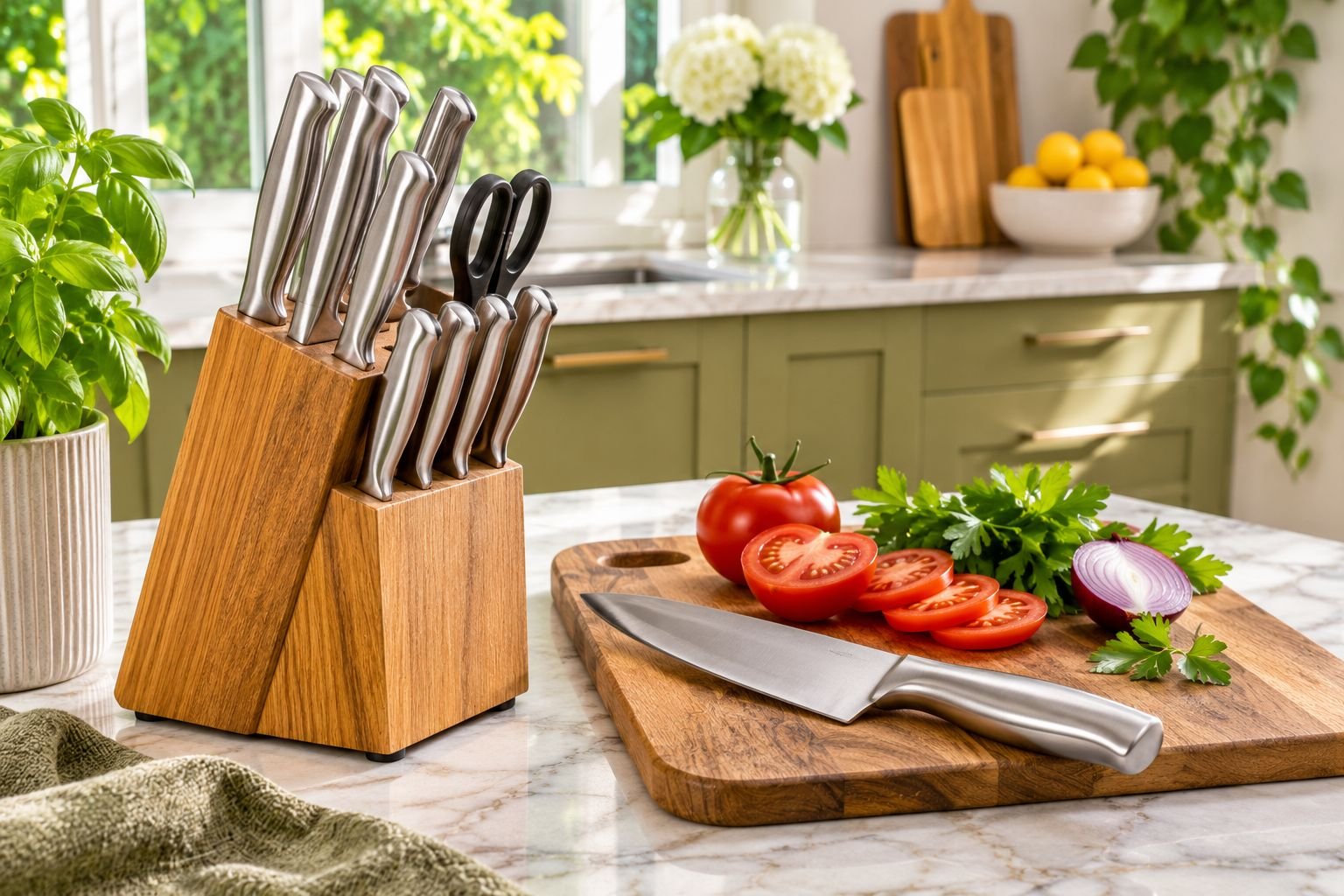
The short answer
For most home cooks, the HENCKELS Statement block set is the best kitchen knife set: it's sharp out of the box, light, well made and includes steak knives, shears and a sharpener. On a tight budget, the McCook block set costs much less and has a sharpener built into the block. If you'd rather own fewer, better knives for life, the WÜSTHOF Classic 7-piece set gives you fully forged German knives that chefs have trusted for decades. Most people only use three knives every day: a chef's knife, a paring knife and a bread knife.
- You only need three knives for most cooking — chef's, paring and serrated bread. Everything else is a bonus.
- Big 15–20 piece sets look like value, but many of the pieces go unused. Compare the quality of the chef's knife first.
- German knives are tougher and easier to care for; Japanese knives are harder, lighter and sharper but chip more easily.
- Hone often, sharpen rarely, and never put good knives in the dishwasher.
- Forged knives are heavier and more durable; stamped knives are lighter and cheaper.
A good knife makes cooking faster, safer and more enjoyable. A dull one slips, crushes food and turns dinner into a chore. But walk into any shop and you’ll see 20-piece sets next to 7-piece sets that cost five times as much. It’s hard to know what you’re paying for.
This guide makes it simple. Our three picks cover a budget set, a great all-rounder and a buy-for-life set. After them, we explain which knives you actually need, German vs Japanese steel, and how to keep any knife sharp for years.
Our picks at a glance
| Feature | Best overallHENCKELS Statement Knife Set with Block (20-piece) | Budget pickMcCook 15-Piece Knife Block Set with Built-in Sharpener | Premium pickWÜSTHOF Classic 7-Piece Knife Block Set |
|---|---|---|---|
| Best for | Most home cooks who want a complete, sharp German-style set at a fair price | First kitchens, rentals and anyone on a tight budget | Keen cooks who want fewer, better knives that last a lifetime |
| Price band | Mid-range | Budget | Premium |
| Steel | German stainless steel | Stainless steel | German stainless steel |
| Construction | Stamped | — | Fully forged |
| Pieces | 20 incl. block | 15 incl. block | 7 incl. block |
| Care | Hand-wash recommended | Hand-wash recommended | Hand-wash only |
| Where to buy | Check price | Check price | Check price |
Best overall: HENCKELS Statement knife set
HENCKELS (the value line from the makers of ZWILLING) is the set we’d recommend to most home cooks. The stamped German stainless blades are sharp out of the box and light enough that they don’t tire your wrist. The set also covers everything: chef’s, bread, utility and paring knives, plus steak knives, kitchen shears and a sharpener. It’s rated 4.5 stars by more than 25,000 US owners and is sold in both the US and Australia.
The trade-offs: stamped blades feel lighter and less hefty than forged ones, which some cooks dislike. Like any good knife, they need hand-washing to stay sharp.
Best budget pick: McCook knife block set
If you’re setting up a first kitchen or a rental, the McCook set gives you a full block of knives for not much money. Its clever feature is a sharpener built into the block slot, so the edge gets a light touch-up each time you pull the knife out and put it back. It’s rated 4.6 stars by more than 36,000 US owners.
The trade-offs: the softer steel loses its edge sooner than premium knives, and you’ll probably never use every piece in a 15-piece set.
Best premium pick: WÜSTHOF Classic 7-piece set
WÜSTHOF has made knives in Solingen, Germany, for more than 200 years, and the Classic line is a kitchen staple for professional and home cooks alike. Every blade is fully forged from one piece of steel. They’re well balanced, durable and easy to resharpen.
This set gives you only what you’ll use: a chef’s knife and a few smaller knives, with a honing steel and shears in a compact block. Rated 4.8 stars.
The trade-offs: it’s expensive, and forged knives are heavier, which not everyone likes.
The only knives you really need
| Knife | Size | What it’s for |
|---|---|---|
| Chef’s knife | 20 cm (8 in) | 80% of cooking: chopping, slicing, dicing, mincing |
| Paring knife | 8–10 cm (3–4 in) | Peeling, trimming, small in-hand jobs |
| Bread knife (serrated) | 20–25 cm (8–10 in) | Bread, tomatoes, cakes, citrus |
| Utility knife | 12–15 cm (5–6 in) | Sandwiches, small vegetables. Nice to have |
| Santoku | 15–18 cm (6–7 in) | A Japanese-style alternative to the chef’s knife |
| Steak knives | — | For the table, not for prep |
| Kitchen shears | — | Herbs, packaging, trimming chicken |
| Honing steel | — | Keeps the edge straight between sharpenings |
When you compare sets, judge them by the chef’s knife. That’s the one you’ll use every day.
How to choose a knife set
1. German or Japanese steel?
| German style | Japanese style | |
|---|---|---|
| Steel | Softer, tougher | Harder |
| Edge angle | Wider (about 14–20° per side) | Thinner (about 10–15° per side) |
| Feel | Heavier, sturdy | Lighter, nimble |
| Sharpness | Very sharp | Extremely sharp |
| Care | Forgiving and easy to sharpen | Can chip on bones or frozen food |
| Best for | Most home cooks | Precise slicing and keen cooks |
2. Forged or stamped?
- Forged: heavier, better balanced, with a bolster that protects your fingers. Lasts a lifetime.
- Stamped: lighter and cheaper. Good stamped knives are still very sharp and easy to use.
3. Handles
Pick a handle you can grip securely with wet hands. Synthetic (POM) handles are durable and hygienic, and wood looks lovely but needs more care. If you can, hold a chef’s knife before you buy.
4. How many pieces?
Big sets pad the count with the block, steak knives and shears. Count the prep knives instead. A 7-piece set with three excellent knives often beats a 20-piece set of average ones.
5. Storage
A block keeps a set together and protects the edges. A magnetic strip saves bench space and lets blades dry. Avoid loose drawers.
How to keep your knives sharp
- Hone often. A few light strokes on a honing steel before you cook straightens the edge. It doesn’t remove metal.
- Sharpen every few months. Use a whetstone, a quality pull-through sharpener or a professional service. Honing can’t fix a truly dull knife.
- Use the right board. Wood or soft plastic boards are kind to edges. Glass, stone and marble boards dull knives fast.
- Hand-wash and dry straight away. Dishwashers dull the edges and damage handles.
- Use the right knife for the job. Don’t cut through bones or frozen food with a chef’s knife.
Knife safety basics
- A sharp knife is safer than a dull one, because it doesn’t slip.
- Curl your fingertips under (“the claw”) when chopping.
- Put a damp cloth under your board so it doesn’t slide.
- Never try to catch a falling knife.
Got the knives? Put them to work in a cast iron skillet, or read our comparison of cast iron vs carbon steel vs nonstick pans.
Common questions
What knives does a home cook really need?
Three cover almost everything. A chef's knife (20 cm / 8 in) does most chopping, slicing and dicing. A paring knife handles small, in-hand jobs like peeling and trimming. A serrated bread knife cuts bread, tomatoes and cakes cleanly. Add kitchen shears and a honing steel and you have a complete kit.
Are expensive knife sets worth it?
A good chef's knife is worth paying for, because you use it every day. Expensive sets are worth it if you'll use most of the knives and look after them, since forged German or Japanese knives can last decades. Big cheap sets are fine for starter kitchens but dull faster.
Is it better to buy a knife set or individual knives?
If you only want three or four knives, buying them individually usually gets you better quality for the money. A set makes sense if you want a matching block, steak knives and everything in one go, or if it's a gift.
What's the difference between German and Japanese knives?
German knives use slightly softer, tougher steel with a wider edge angle, so they're durable, forgiving and easy to sharpen. Japanese knives use harder steel with a thinner edge, so they're lighter and sharper but more likely to chip if used on bones or frozen food.
What's the difference between forged and stamped knives?
Forged knives are shaped from a single heated bar of steel, usually with a thick bolster where blade meets handle. They're heavier, balanced and very durable. Stamped knives are cut from a flat sheet. They're lighter and cheaper, and good stamped knives can still be very sharp.
How often should I sharpen my kitchen knives?
Hone them with a honing steel every few uses to straighten the edge, and sharpen them properly (with a whetstone, pull-through sharpener or professional service) every few months for a home cook. If a knife slides off a tomato skin, it's time.
Can I put kitchen knives in the dishwasher?
It's best not to, even if the box says dishwasher safe. Heat, harsh detergent and knocking against other items dull the edge and can damage handles. Hand-wash, dry straight away and put the knife back in the block.
Is a knife block or a magnetic strip better?
Both are fine. A block protects the edges and keeps a set together but takes bench space and is hard to clean inside. A magnetic strip saves space and lets the blades dry fully. Never store good knives loose in a drawer, where the edges bang together.
Sources
Keep reading
The Best Air Fryer Toaster Oven: Combo Picks That Replace Two Appliances
The best air fryer toaster oven combos, how they compare with basket air fryers, what size you need, and which save bench space, with picks for every budget.
The Best Dutch Oven: Enameled vs Cast Iron, What Size, and Is Le Creuset Worth It?
The best Dutch ovens for stews, braises and bread, enameled vs bare cast iron, what size to buy, and whether Le Creuset is worth the price.
The Best Food Storage Containers: Glass vs Plastic, Leak-Proof and Meal-Prep Picks
The best food storage containers for leftovers, lunches and meal prep, glass vs plastic, which are leak-proof and microwave safe, and how long food keeps.