The Best Compost Bins: Tumblers, Backyard Bins and Kitchen Caddies
The best compost bins for every yard, tumbler vs open bin explained, what you can and can't compost, and how to keep compost fast, sweet-smelling and rat-free.
We earn a commission if you buy through links on this page, at no extra cost to you. Learn more.
The short answer
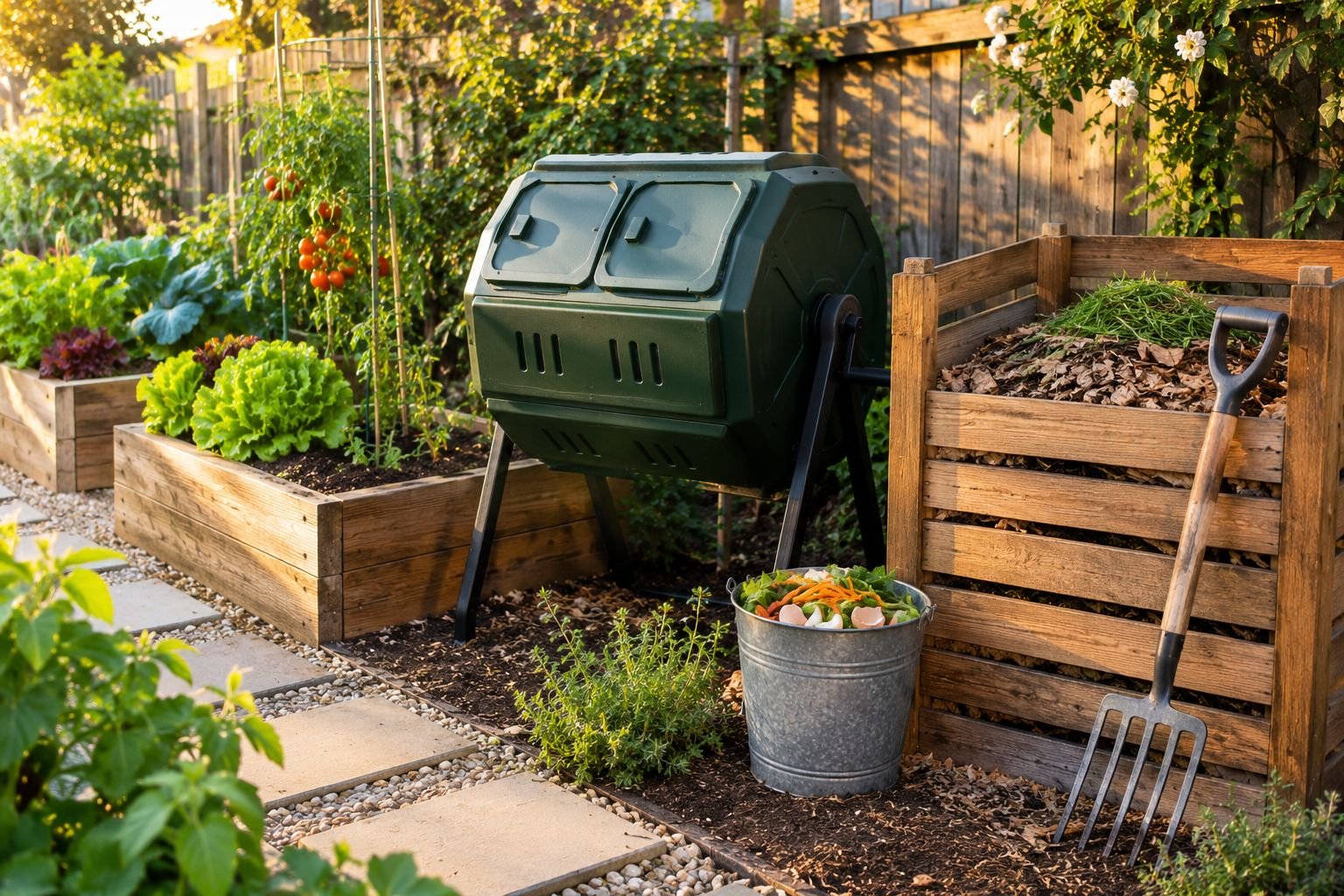
For small and medium yards, a raised compost tumbler like the FCMP Outdoor tumbling composter is the best compost bin: it's sealed against pests and you mix it by turning it a few times a week. For big gardens with lots of leaves and grass, a large open bin like the GEOBIN is cheapest per litre of compost. To collect scraps indoors, the OXO Easy-Clean kitchen caddy is easy to empty and wash. Whatever bin you choose, mix roughly 2 parts browns (leaves, cardboard) to 1 part greens (food scraps, grass) and keep it as damp as a wrung-out sponge.
- Tumblers are best for small yards, pests and speed. Open bins are best for big volumes.
- Mix browns (carbon) and greens (nitrogen). Too many greens makes compost smelly and slimy.
- Keep compost damp like a wrung-out sponge, and turn or mix it to add air.
- Keep meat, dairy, oily food and pet poo out of home compost bins.
- Bury food scraps under browns and keep lids closed to deter rats and flies.
Composting turns kitchen scraps and garden waste into free, rich compost for your vegetable beds and pots, and keeps a big chunk of your rubbish out of landfill. The hard part isn’t the science. It’s choosing a bin that suits your space and doesn’t turn into a smelly, rat-filled heap.
This guide picks the best compost bins for different gardens, explains tumbler vs open bin, and gives you a simple recipe for fast, sweet-smelling compost.
All picks were checked on Amazon US and Amazon Australia.
Our picks at a glance
| Feature | Best kitchen caddyOXO Good Grips Easy-Clean Compost Bin (6.6 L) | Best tumblerFCMP Outdoor Tumbling Composter | Best for big gardensGEOBIN Expandable Compost Bin (246 gal) |
|---|---|---|---|
| Best for | Collecting food scraps in the kitchen before they go outside | Small and medium yards, fast compost, keeping pests out | Large gardens with lots of leaves, grass and prunings |
| Price band | Budget | Mid-range | Budget |
| Type | Kitchen caddy | Tumbler | Open bin |
| Capacity | 1.75 gal (6.6 L) | 37 gal (140 L) | Up to 246 gal (930 L) |
| Pest-resistant | Indoor use | Yes (raised and sealed) | No |
| Where to buy | Check price | Check price | Check price |
Best tumbler: FCMP Outdoor tumbling composter
For most small and medium yards, a tumbler is the easiest way to compost. The FCMP sits off the ground and seals shut, so rats, dogs and possums can’t get in. Instead of forking a heap, you close the door and give it a few turns every couple of days. Inside fins break up clumps and mix in air. It’s made from recycled plastic and has more than 18,000 ratings at 4.5 stars. The dual-chamber version lets one side finish while you keep filling the other.
The trade-offs: it holds less than an open bin, and it gets heavy to turn when full and wet. Add plenty of browns to keep it light and fluffy.
In Australia, the US model ships as an expensive import, so the Australian link shows local compost tumblers instead.
Best for big gardens: GEOBIN expandable compost bin
If you have lots of leaves, grass clippings and prunings, an open bin is the cheapest way to compost in bulk. The GEOBIN is a ring of vented recycled plastic that clips into a circle up to about 1.2 m (4 ft) wide. It sets up in minutes and holds up to 930 litres. Rated 4.4 stars by thousands of owners in both stores.
The trade-offs: it’s open at the top and bottom, so it isn’t pest-proof. Use it mostly for garden waste, and bury any food scraps deep under browns. You’ll need a garden fork to turn it.
Best kitchen caddy: OXO Good Grips Easy-Clean compost bin
A good kitchen caddy is what makes composting a habit. The OXO has smooth sides that are easy to clean, it’s dishwasher safe, and the lid flips open with one hand and stays up while you scrape a plate. It holds 6.6 litres, about two or three days of scraps for most families, and fits on the bench or under the sink.
The trade-offs: there’s no carbon filter, so empty it every few days.
Which compost bin is right for you?
| Your situation | Best type | Why |
|---|---|---|
| Small yard, beginner | Tumbler | Tidy, pest-resistant, easy to mix |
| Rats, possums or dogs nearby | Sealed tumbler | Off the ground and fully closed |
| Big garden, lots of leaves and grass | Open or wire bin | Huge capacity, low cost |
| Want compost fast | Tumbler or a hot-composting bin | Regular mixing adds air |
| Apartment or balcony | Worm farm or bokashi bucket | Small, no garden needed |
| Every home | Kitchen caddy | Makes collecting scraps easy |
What to put in your compost bin
The US EPA says home compost needs a balance of browns, greens and water. Browns include dead leaves, branches and twigs; greens include grass clippings, vegetable waste, fruit scraps and coffee grounds.
| Greens (nitrogen) | Browns (carbon) | Keep out of home bins |
|---|---|---|
| Fruit and vegetable scraps | Dry leaves | Meat, fish and bones |
| Coffee grounds and tea bags | Shredded cardboard and paper | Dairy, oil and greasy food |
| Fresh grass clippings | Straw and wood chips | Dog and cat poo |
| Plant trimmings | Egg cartons | Diseased plants |
| Eggshells (crushed) | Small twigs and prunings | Weeds with seed heads |
The easy ratio: about 2 parts browns to 1 part greens by volume. Every time you add a caddy of food scraps, add a couple of handfuls of shredded cardboard or dry leaves.
How to make compost faster
- Chop it small. Smaller pieces break down much faster.
- Balance browns and greens. Smelly and slimy means add browns. Dry and slow means add greens and water.
- Keep it damp. It should feel like a wrung-out sponge.
- Add air. Turn a tumbler a few times a week, or fork an open bin every week or two.
- Fill in batches if you can. A full bin heats up and breaks down faster than one that’s always being topped up.
- Harvest from the bottom. Finished compost is dark, crumbly and smells like a forest floor.
Common problems and fixes
| Problem | Cause | Fix |
|---|---|---|
| Rotten-egg or ammonia smell | Too wet or too many greens | Add browns and mix |
| Nothing happening | Too dry or too many browns | Add water and greens, then mix |
| Fruit flies | Exposed food scraps | Bury scraps under browns, close the lid |
| Rats or mice | Food scraps in an open bin | Use a sealed tumbler, keep meat and dairy out |
| Ants | Compost too dry | Add water and mix |
Using your compost? See our guides to how much soil you need for a raised garden bed, the best wood for raised garden beds and the best pruning shears.
Common questions
What is the best type of compost bin for beginners?
A compost tumbler is the easiest for most beginners. It's sealed against pests, there's no forking, and turning it a few times a week keeps the compost mixed and aerated.
Are compost tumblers better than compost bins?
Tumblers are faster to mix, tidier and better at keeping pests out, but they hold less. Open or stationary bins hold far more garden waste and cost less, but need turning with a fork and are harder to protect from rats.
How long does compost take?
A well-mixed, regularly turned pile can be ready in about 2–5 months in warm weather. A pile you leave alone can take 6–12 months. Finished compost is dark, crumbly and smells like soil.
What should not go in a compost bin?
Avoid meat, fish, bones, dairy, oily or greasy food, pet poo, diseased plants, weeds with seeds, and treated or painted wood. These can smell, attract pests or spread problems in a home bin.
Why does my compost smell bad?
A rotten-egg or ammonia smell usually means it's too wet or has too many greens. Add dry browns like shredded cardboard or leaves, mix well, and make sure it gets air.
How do I keep rats out of my compost bin?
Use a sealed tumbler or a bin with a secure lid and a mesh base, bury food scraps under browns, and keep meat, dairy and cooked food out.
Where should I put my compost bin?
On level ground in a convenient spot, ideally part sun and part shade, near a tap and close enough to the kitchen that you'll actually use it. Open bins work best on bare soil so worms can get in.
Do I need a kitchen compost bin?
Not strictly, but a small kitchen caddy makes composting much easier. Collect scraps in it and empty it into the outdoor bin every few days.
Sources
Keep reading

Best Wood for Raised Garden Beds (and the Best Raised Bed Kits to Buy)
Which timber lasts longest in a raised vegetable bed, which is safe for food, what to avoid — plus three raised bed kits sold in the US and Australia.
How much soil do you need for a raised garden bed? (Calculator + best mix)
Work out exactly how much soil your raised bed needs in liters or cubic feet, what mix to fill it with, and how to cut the cost of filling it.
The Best Garden Hose: Kink-Free, Lightweight and Built-to-Last Picks
The best garden hoses, from a light hybrid to rubber that lasts for years, plus how to choose size, length and material and stop kinks and leaks.