The Best Knife Sharpeners: Pull-Through, Whetstone and Electric Picks
The best knife sharpeners for every skill level, honing vs sharpening explained, and step-by-step whetstone and pull-through sharpening guides.
We earn a commission if you buy through links on this page, at no extra cost to you. Learn more.
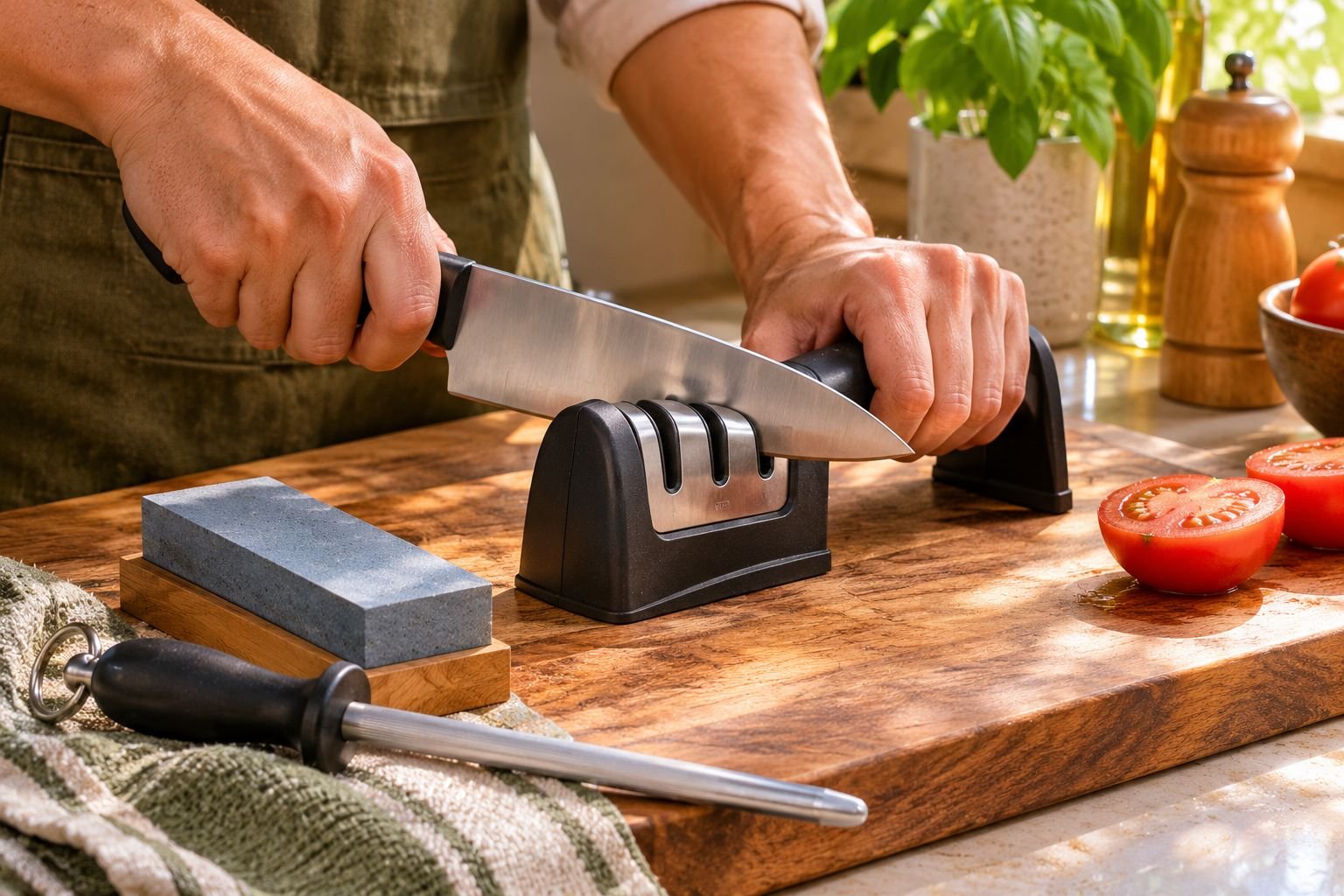
The short answer
For the sharpest edge and the longest knife life, a 1000/6000 whetstone like Sharp Pebble is the best knife sharpener. It takes a little practice but works on every straight-edge knife, Japanese ones included. For quick, easy results with no skill, the Longzon pull-through sharpener costs very little and has more than 38,000 ratings. If you have lots of knives and want speed and consistency, the Chef'sChoice 15XV electric sharpener is the premium pick. Between sharpenings, hone your knife on a steel to keep the edge aligned.
- Honing realigns the edge between sharpenings; sharpening removes steel to make a new edge.
- Whetstones give the sharpest edge and remove the least steel, but take practice.
- Pull-through sharpeners are fast and foolproof, but remove more steel.
- Electric sharpeners are fast and consistent for big knife collections.
- Check your knife's angle. Japanese knives are usually sharper (about 15°) than Western ones (about 20°).
A sharp knife is safer and faster than a dull one. It glides through tomatoes and onions instead of slipping off them, so you need less force and are less likely to cut yourself. Even the best knives go dull with use, and a good sharpener keeps them cutting like new for years.
This guide picks the best knife sharpeners for every skill level, explains the difference between honing and sharpening, and shows you how to sharpen with a whetstone and a pull-through sharpener.
All picks were checked on Amazon US and Amazon Australia.
Our picks at a glance
| Feature | Best budgetLongzon 4-Stage Knife Sharpener with Cut-Resistant Glove | Best overallSharp Pebble Whetstone 1000/6000 Grit with Bamboo Base | Best electricChef'sChoice 15XV EdgeSelect Electric Knife Sharpener |
|---|---|---|---|
| Best for | Quick, easy sharpening for everyday kitchen knives | The sharpest edge and the longest knife life, for anyone willing to learn | Fast, consistent edges with no skill needed, for big knife collections |
| Price band | Budget | Budget | Premium |
| Type | Manual pull-through | Whetstone (1000/6000) | Electric (3-stage) |
| Learning curve | None | Moderate | None |
| Best for | Western kitchen knives | All straight-edge knives | Western and Asian-style knives |
| Where to buy | Check price | Check price | Check price |
Best overall: Sharp Pebble 1000/6000 whetstone
A whetstone gives the sharpest possible edge and removes the least steel, so your knives last longer. The Sharp Pebble has a 1000 grit side to sharpen and a 6000 grit side to polish, plus a non-slip bamboo base and an angle guide to help you hold the knife steady. It works on almost any straight-edge knife, from cheap chef’s knives to Japanese blades, and more than 24,000 owners rate it 4.6 stars in each store.
The trade-offs: it takes some practice, and it’s slower than a pull-through sharpener.
Best budget: Longzon 4-stage pull-through sharpener
If you want sharp knives with no learning curve, a pull-through sharpener is the answer. The Longzon has coarse, fine and polishing slots, a scissor sharpener and a cut-resistant glove. You just pull the knife through a few times. With more than 38,000 ratings in each store, it’s one of Amazon’s most popular sharpeners.
The trade-offs: it removes more steel than a whetstone, and it isn’t suitable for Japanese or serrated knives.
Best electric: Chef’sChoice 15XV
For big knife collections or anyone who wants fast, consistent results, the 15XV is a classic. It uses diamond abrasives in three stages to sharpen, hone and polish, and puts a sharp 15-degree edge on Western and Asian-style knives. More than 14,000 owners rate it 4.6 stars.
The trade-offs: it’s expensive, it can remove steel quickly if overused, and the US model runs on 120V, so our Australian link shows local electric sharpeners.
Honing vs sharpening: what’s the difference?
| Honing | Sharpening | |
|---|---|---|
| What it does | Straightens the edge that bends with use | Grinds away steel to make a new edge |
| Tool | Honing steel or ceramic rod | Whetstone, pull-through or electric sharpener |
| How often | Weekly or before each use | Every 2–6 months for home cooks |
| Removes steel | Very little or none | Yes |
Made In explains that a honing steel, though often called a sharpening steel, is used to hone a blade rather than sharpen it, while sharpening uses a whetstone or electric sharpener to remove steel and make a new edge.
Which knife sharpener suits you?
| Your situation | Best choice | Why |
|---|---|---|
| Beginner, want quick results | Pull-through | No skill needed |
| Want the sharpest edge and longest knife life | Whetstone | Removes least steel |
| Lots of knives, want speed | Electric | Fast and consistent |
| Japanese knives | Whetstone | Suits harder steel and finer angles |
| Serrated knives | Ceramic rod or serrated slot | Follows the scallops |
| Between sharpenings | Honing steel | Keeps the edge aligned |
How to sharpen a knife with a whetstone
- Soak the stone in water for 10–15 minutes, until bubbles stop (unless it’s a splash-and-go stone).
- Place it on its non-slip base, 1000 grit side up, on a damp towel.
- Hold the knife at about 15–20°. Two stacked coins under the spine are a handy guide.
- Push the blade across the stone from heel to tip, with light, even pressure. Do 10 strokes on one side.
- Feel for a burr, a tiny rough lip along the opposite side of the edge, then repeat on the other side.
- Switch to the 6000 grit side and repeat with lighter strokes to polish.
- Rinse and dry the knife, then test it on a tomato or a sheet of paper.
How to use a pull-through sharpener
- Place the sharpener on a flat surface and hold the handle firmly.
- Pull the knife through the coarse slot 3–5 times with light pressure, heel to tip.
- Pull it through the fine slot 5–10 times.
- Finish with a few strokes in the polishing slot, if there is one.
- Wipe the blade clean.
Knife care tips
- Hone weekly, or before each use for busy kitchens.
- Use wooden or plastic cutting boards. Glass, marble and ceramic boards dull edges fast.
- Hand-wash and dry knives straight away. Dishwashers dull and damage blades.
- Store knives in a block, on a magnetic strip or with blade guards, not loose in a drawer.
Need new knives? See our guide to the best kitchen knife sets.
Common questions
What is the best type of knife sharpener?
A whetstone gives the sharpest, longest-lasting edge and removes the least steel, but takes practice. Pull-through sharpeners are easiest. Electric sharpeners are fastest for many knives.
What's the difference between honing and sharpening?
Honing on a steel realigns the tiny edge that bends during use, and should be done often. Sharpening grinds away steel to form a brand-new edge, and is only needed every few months for home cooks.
How often should I sharpen my kitchen knives?
Most home cooks need to sharpen every 2–6 months, and hone every week or before each use. If a knife squashes a tomato instead of slicing it, it needs sharpening.
What grit whetstone should I buy?
A 1000/6000 combination stone suits most home cooks. 1000 grit sharpens a dull edge, and 6000 polishes it. Very dull or chipped knives may need a coarse 400 grit stone first.
Do pull-through sharpeners ruin knives?
Not if used gently and only when needed. They remove more steel than a whetstone and can wear knives faster with heavy use, so use light pressure and a few strokes.
Can I sharpen Japanese knives with a pull-through sharpener?
It's not recommended. Japanese knives are harder and sharpened to a finer angle, so a whetstone or a sharpener designed for 15° edges is better.
Can I sharpen serrated knives?
Yes, but only with a tapered ceramic rod or a sharpener with a dedicated serrated slot. Standard whetstones and pull-through slots aren't suitable.
Sources
Keep reading
The Best Kitchen Knife Set: Which Knives You Actually Need (and Which to Skip)
The best kitchen knife sets for every budget, which knives you really need, German vs Japanese steel, and how to keep your knives sharp for years.
The Best Electric Kettles: Fast, Plastic-Free and Gooseneck Picks
The best electric kettles for tea, coffee and everyday use, plastic-free vs gooseneck explained, water temperatures for every drink, and how to descale.
The Best Air Fryer Toaster Oven: Combo Picks That Replace Two Appliances
The best air fryer toaster oven combos, how they compare with basket air fryers, what size you need, and which save bench space, with picks for every budget.