How to Clean a Shower Head (Without Removing It) and Get Your Pressure Back
How to clean a shower head with vinegar, with or without removing it, how long to soak, and how to unclog the nozzles and filter screen.
We earn a commission if you buy through links on this page, at no extra cost to you. Learn more.
The short answer
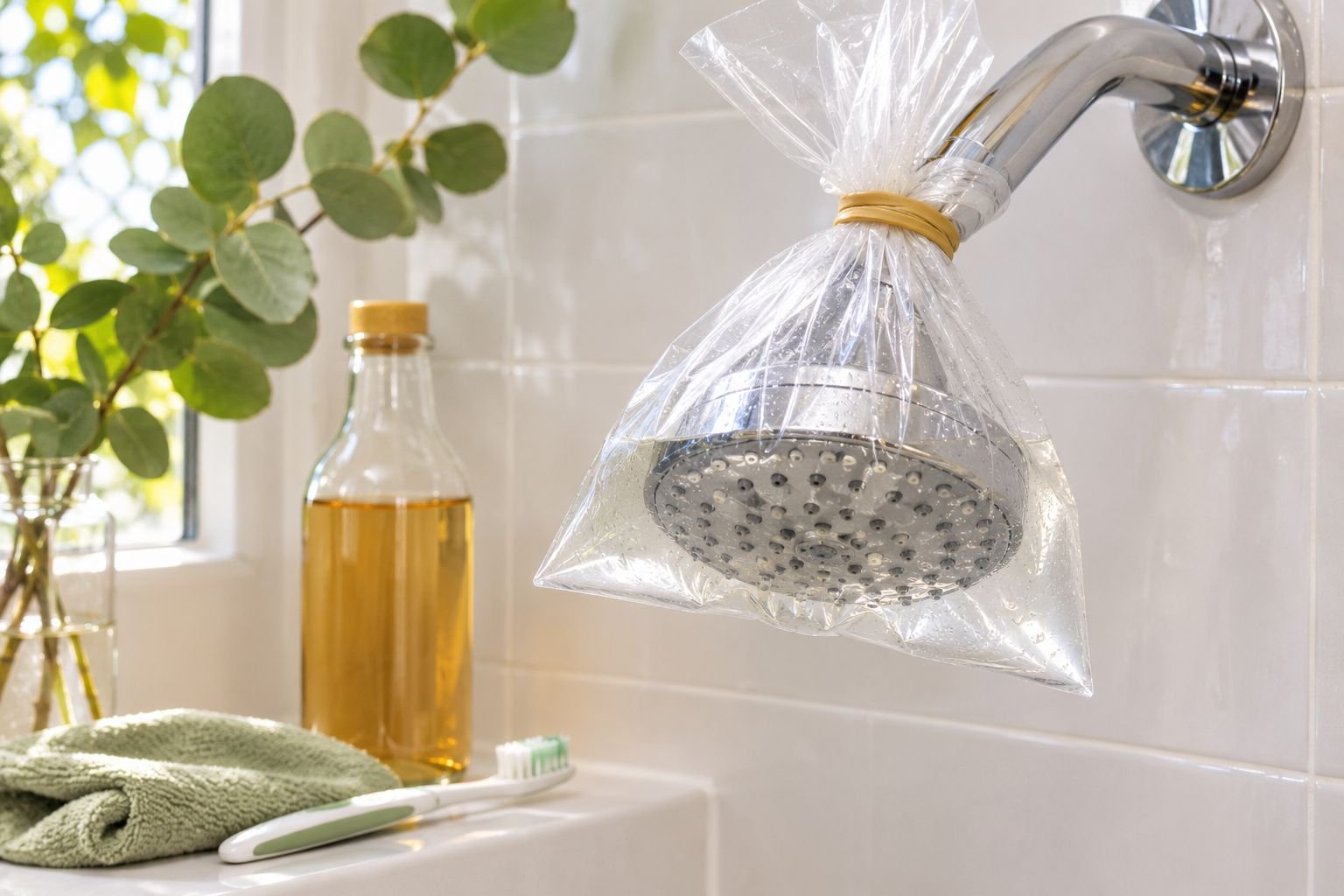
To clean a shower head without removing it, fill a plastic bag with white vinegar, tie it over the head with a rubber band so the nozzles are submerged, and leave it for 30 minutes to a few hours (overnight for heavy build-up). Then remove the bag, scrub the nozzles with an old toothbrush, rub the rubber nozzles with your finger, clear stubborn holes with a toothpick, and run hot water for a minute. If pressure is still weak, remove the head and clean the small filter screen inside the connection.
- The vinegar bag method cleans most shower heads without tools or removing them.
- Soak 30 minutes for a monthly clean, a few hours to overnight for heavy build-up.
- Check your finish first. Long soaks can dull some brass, gold and coated finishes.
- Rub rubber nozzles with your finger, and clear stubborn holes with a toothpick.
- Still weak? Clean the filter screen inside the connection.
If your shower has gone from a strong, even spray to a few wild jets and a dribble, the shower head probably isn’t broken. It’s blocked with limescale, the white mineral crust that builds up from hard water. Cleaning it takes about five minutes of work, plus soaking time, and usually brings the pressure straight back.
This guide shows you the easy vinegar bag method that doesn’t need any tools, how to deep clean a badly clogged head, and how to keep it clean.
What you’ll need
- White vinegar (or citric acid)
- A plastic bag and a rubber band or zip tie
- An old toothbrush
- A toothpick or safety pin
- A soft cloth
- Optional: an adjustable wrench and a cloth, if you remove the head
Method 1: Clean a shower head without removing it (vinegar bag)
This is the easiest method and works for most fixed shower heads.
- Fill a plastic bag about halfway with white vinegar.
- Pull the bag up over the shower head so all the nozzles are under the vinegar, and secure it around the arm with a rubber band or zip tie.
- Let it soak. About 30 minutes for a regular clean, or a few hours to overnight for heavy build-up.
- Remove the bag and pour the vinegar down the drain.
- Scrub the face with an old toothbrush, paying attention to each nozzle.
- Rub the rubber nozzles with your finger to pop out loosened scale.
- Clear any stubborn holes with a toothpick or safety pin.
- Run hot water for a minute to flush out loosened scale, then wipe the outside dry.
Shower makers recommend the finger trick too. Waterpik notes that many heads have flexible rubber nozzles that you can clear by massaging each one with your finger or gently scrubbing with a toothbrush.
Check your finish first. Vinegar is safe for chrome, but long soaks can dull some brass, gold, nickel and coated finishes. For those, keep the soak short and check the maker’s care instructions.
Method 2: Deep clean a badly clogged shower head
If the nozzles are badly blocked or the spray is still weak, remove the head for a deeper clean.
- Unscrew the shower head anticlockwise. If it’s tight, wrap a cloth around the nut and use an adjustable wrench.
- Soak it in a bowl of white vinegar, or warm water with citric acid, for a few hours or overnight.
- Clean the filter screen. Inside the connection there’s often a small mesh screen. Pull it out with tweezers, rinse it, and scrub off any grit.
- Scrub and clear the nozzles with a toothbrush and toothpick, then rinse well.
- Clean the shower arm thread with the toothbrush to remove old tape and scale.
- Rewrap the thread with 3–4 turns of plumber’s tape, then screw the head back on hand-tight.
- Run the water and check for drips.
Delta suggests cleaning debris such as old tape and rust off the shower arm thread while the head is off, so it’s ready to reinstall.
How often should you clean your shower head?
| Your water | How often |
|---|---|
| Hard water (white crust on taps and glass) | Every 1–2 months |
| Medium hardness | Every 2–3 months |
| Soft water | Every 3–6 months |
| Holiday home or rarely used shower | Before you use it again |
Regular cleaning keeps the shower working properly. The New Jersey Department of Health’s guidance notes that minerals in water build up over time and block the nozzles, and that regular cleaning keeps the shower head working.
Products that help
If vinegar isn’t shifting thick, crusty scale, a stronger limescale remover works faster. In hard water areas, an inline filter can reduce chlorine and sediment, and a 2-in-1 head makes cleaning the shower walls easier.
| Feature | Best for hard waterAquaBliss High Output Shower Filter (SF100) | Best overallMoen Engage 2-in-1 Showerhead & Handshower |
|---|---|---|
| Best for | Hard or chlorinated water, dry skin and limescale build-up | Most bathrooms — a fixed head that pops off to become a handshower |
| Price band | Budget | Mid-range |
| Type | Inline shower filter | 2-in-1 fixed + handheld |
| Finish | Chrome | Spot-resist nickel |
| Flow (US) | Depends on your shower head | 2.5 GPM (9.5 L/min) |
| Where to buy | Check price | Check price |
Troubleshooting
| Problem | Likely cause | Fix |
|---|---|---|
| Weak spray from all nozzles | Blocked filter screen | Remove the head and clean the screen |
| Some nozzles spray sideways | Scale on individual nozzles | Rub nozzles, clear with a toothpick |
| Black spots on the face | Mould | Scrub with a mild bathroom cleaner |
| Leaks at the joint after refitting | Old tape or worn washer | Rewrap the thread, replace the washer |
| Still weak after cleaning | Low household pressure or a worn head | Check other taps, or replace the head |
If your shower head is old or the finish is peeling, it may be time for a new one. See our guide to the best shower heads.
Keep it clean for longer
- Wipe the face dry after showering once or twice a week.
- Rub the rubber nozzles with your thumb when you shower.
- Run the exhaust fan during and after showers to reduce mould.
- Do a 30-minute vinegar bag soak monthly if you have hard water.
More bathroom and cleaning help: how to get rid of fruit flies and how to clean hardwood floors.
Common questions
How long should I soak my shower head in vinegar?
About 30 minutes for a regular monthly clean, and a few hours to overnight for heavy limescale. For brass, gold, nickel or coated finishes, keep soaks short and check the manufacturer's care instructions.
Can I clean a shower head without removing it?
Yes. Tie a plastic bag of white vinegar over the head with a rubber band or zip tie so the nozzles are covered, let it soak, then scrub and rinse. It's the easiest method and needs no tools.
Why is my shower head pressure still low after cleaning?
There may be debris on the small filter screen inside the connection where the head screws onto the arm. Unscrew the head, pull out the screen with tweezers, rinse it, and refit it. Also check the water pressure at other taps.
Can I use bleach to clean a shower head?
Bleach doesn't dissolve limescale, which is what usually blocks nozzles, and it can damage some finishes. Use vinegar for scale, and a mild bathroom cleaner for mould on the outside.
How often should I clean my shower head?
Every 1–2 months in hard water areas, and every few months in soft water areas. Clean it sooner if the spray gets uneven or weak.
What can I use instead of vinegar?
Citric acid (about 1 tablespoon per litre of warm water) works well and smells less. Commercial limescale removers work faster on heavy build-up, but can damage some finishes, so test first.
Do I need to clean a handheld shower head differently?
No. You can soak the handheld in a bowl of vinegar instead of a bag. Also wipe the hose and check the washer at each end when you reconnect it.
Sources
Keep reading

The Best Shower Heads for Strong Water Pressure (and Lower Water Bills)
The best shower heads for strong pressure, handheld rinsing and hard water, how flow rates and WELS stars work, and how to install one in 10 minutes.
The Best Carpet Cleaners for Home: Upright Washers and Spot Cleaners
The best carpet cleaner machines for home, upright vs portable spot cleaners, how to deep clean carpet like a pro, and how to remove pet stains properly.
The Best Clothes Drying Racks for Small Spaces, Big Loads and Winter
The best clothes drying racks for apartments, families and winter, plus folding vs wall-mounted vs heated airers and tips to dry clothes faster indoors.